Crane load chart explained: how to read one
A crane load chart is the crane manufacturer's table of rated capacities: the most that crane may lift at each load radius and boom length, for one stated configuration, with notes that set deductions and limits. To read one, check the chart's configuration and notes before looking for a capacity. Then find the correct radius and boom-length entry, read the gross rating and subtract every applicable deduction. A correct subtraction cannot repair a lookup made on the wrong chart.
Every number in the worked examples below comes from Boom Angle's invented Practice A or Practice B. These are original teaching charts, not a manufacturer's chart or an NCCCO exam chart. They are not equipment ratings and cannot authorize a lift. Open load chart practice to follow the examples.
Start with configuration, radius and boom length
Radius is the horizontal distance from the crane's center of rotation to the vertical load line. Boom length is a different measurement; do not use boom length as a substitute for radius. The crane radius and boom angle calculator shows how boom length, boom angle and radius relate. Check the chart's definitions, units and configuration notes before choosing a row or column.
Our invented Practice A is labeled 360° on fully extended outriggers. Practice B is labeled over rear only on fully extended outriggers. Choosing A because it gives a larger number would ignore the configuration. In actual work, identify the exact equipment and applicable chart, including boom arrangement, support configuration, operating area and other conditions in its instructions.
✓ OSHA 1926.1417(a) and (c) address compliance with manufacturer operating procedures and availability of operating information, including rated capacities and load charts. The teaching sequence here does not replace those procedures.
Keep feet and pounds visible beside your arithmetic. An unlabeled number can quietly move from a radius entry to a weight calculation. Say the selection aloud during practice: chart name, configuration, radius row, boom column and gross capacity.
Try one question
Question 1 of the free 10-question check on NCCCO written. No signup. Then ask Hook, the AI study assistant, why the answer is right and the others are wrong.
Operations
Which action creates side loading on a crane boom?
Press A-D or 1-4 to choose an answer while this question is on screen.
Choose an answer to begin
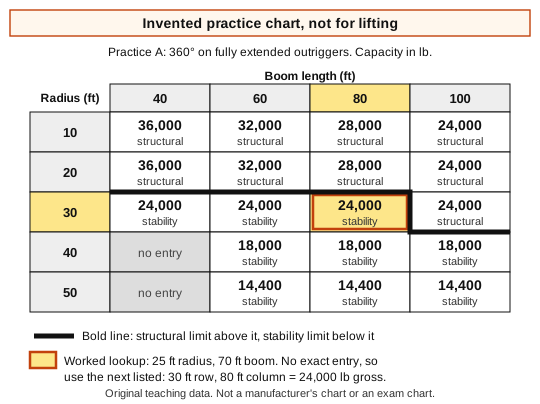
Worked lookup on invented Practice A
Suppose the training setup specifies a 25 ft radius and 70 ft main boom. Only these invented charts instruct you to select the next listed entry at or above each dimension when an exact entry is missing. Therefore:
- Select the 30 ft radius row.
- Select the 80 ft boom column.
- Read 24,000 lb gross capacity from that cell.
Use this diagram
The free sling angle and crane capacity formula sheet prints the load chart arithmetic (net capacity and percent of capacity), with a Practice A example. It does not include the chart.
The invented row list is 10, 20, 30, 40 and 50 ft; the column list is 40, 60, 80 and 100 ft. Do not interpolate a capacity between cells. The rounding rule belongs to these practice charts. An actual crane's instructions determine how unlisted dimensions must be handled.
A blank cell supplies no capacity. For example, the invented 40 ft boom column has no entry at 40 ft radius. Do not fill that blank using a nearby value or your own geometry. In the tool, an unavailable selection stops the calculation rather than producing a rating.
Repeat the 30 ft/80 ft lookup on invented Practice B and the gross value becomes 18,000 lb. Identical row and column labels do not make the two charts interchangeable. The chart selection remains part of the answer.
Ask Hook before you buy AI your AI study assistant
See what's on the NCCCO written exam, test yourself with 5 quick questions, or find the plan that fits you.
The NCCCO written course
Available now · instant accessLearn every outline domain, work load charts step by step, then prove it on timed exams.
- 8modules of lessonsEvery task on the outline
- 3timed practice exams95 questions in 90 minutes and 28 in 60
- 524practice questionsEach one explained
- 2worked calculationsStep by step
- 1week-by-week study planSet to your exam date
Turn a practice answer into a study step. In untimed practice, ask Hook AI about any question you answer, follow up, then see your weakest topics and what to drill next.
Instant access. Terms and refunds · Secure checkout by Stripe · Billed by Nori Software
Every answer comes with a full explanation.
What does the bold line mean?
On our invented charts, the bold line separates cells governed by structural limitation from cells governed by stability limitation. Both are capacity limits. Neither side is permission to disregard the printed value, and the line is not a target operating point.
For invented Practice A at an 80 ft boom length, the 10 ft radius cell is 28,000 lb, structural. The 30 ft radius cell is 24,000 lb, stability. The tool deliberately labels the basis so you can practice noticing the distinction rather than treating every capacity as the same kind of limit.
✓ OSHA 1926.1433(b)(1) and (2) address load-rating requirements where stability and structural competence govern. The rule does not establish a universal visual legend for every chart. On real equipment, read that chart's own legend and notes; do not infer a limitation solely from the position of a bold line.
Gross capacity minus deductions gives net payload capacity
Continue with the invented Practice A gross capacity of 24,000 lb. Select its 600 lb hook block, 800 lb stowed jib and 400 lb rigging. These are the invented tool's deduction values, not typical equipment weights.
| Step | Invented Practice A calculation |
|---|---|
| Total deductions | 600 + 800 + 400 = 1,800 lb |
| Net payload capacity | 24,000 − 1,800 = 22,200 lb |
| Compare a 20,000 lb payload | 20,000 ≤ 22,200 |
| Percentage of net payload capacity | 20,000 ÷ 22,200 × 100 = 90.1% |
The comparison means only that the invented payload is within this arithmetic limit. It is not lift approval. The percentage uses net payload capacity as its denominator; a percentage calculated against gross capacity answers a different question.
In these tools, choose either the hook block or headache ball for the selected hoist attachment, and the stated jib condition. On real equipment, follow the actual chart's deduction instructions and account for the installed and suspended components as required. Do not transfer the practice tool's simplified choices to a crane configuration.
Use the net-capacity calculator to lay out the subtraction. The chart's parts-of-line limit is a separate check: the parts of line calculator finds the fewest parts for a total hook load and line pull. Recheck the source of the gross value and each deduction before accepting a total; a calculator checks arithmetic, not configuration suitability. To see the whole lift as one figure, the crane percent of capacity calculator divides load, rigging and deductions by the chart capacity you read. For plain-English pages on terms used here, such as radius, deductions, working areas and structural versus stability limits, see the crane terms glossary.
Keep chart reading within the full job requirements
✓ OSHA 1926.1404 covers assembly and disassembly requirements, including the configuration and support issues addressed by that section. Those responsibilities cannot be replaced by a load-chart exercise. Read it alongside 1926.1417 and 1926.1433 when studying the regulatory framework.
For study, log mistakes as wrong chart, wrong row or column, overlooked note, missed deduction or arithmetic error. Repeat the underlying step with a different invented setup. If your wrong rows came from a radius between printed values, run the load chart interpolation drill. Read the Core written guide and certification requirements, then use the free written check to choose your next study priorities.
FAQ
What is a crane load chart?
It is the manufacturer's table of rated capacities for one crane: the most it may lift at each load radius and boom length in a stated configuration, such as 360° on fully extended outriggers. The notes beside the grid set the deductions and limits that apply.
Is there a crane load chart example I can work through?
Yes. The worked lookup above reads our invented Practice A at a 30 ft radius and 80 ft boom: 24,000 lb gross, then 22,200 lb net after 1,800 lb of deductions. The chart is drawn as a figure on this page. It is invented for practice and is not a manufacturer's chart.
Where do I find the load chart for a real crane?
In the cab. OSHA 1926.1417(c) requires the crane's operating procedures, including its rated capacities (load charts), to be readily available to the operator there. Use the chart for that exact crane and configuration, never one from another machine or a website.
Is there a crane load chart practice test?
Yes, free: load chart practice gives seeded lookup, deduction and percentage questions on our two invented charts, and the interpolation drill covers a radius between printed rows. For the whole NCCCO written exam, take the free written check.
Is there a crane load chart calculator?
A calculator cannot read a chart for you, but it can check the arithmetic after you do. The net-capacity calculator subtracts deductions from the gross rating, and the crane percent of capacity calculator shows how much of the chart capacity a lift uses.
What is the difference between radius and boom length?
Radius is the horizontal distance from the crane's center of rotation to the vertical load line. Boom length is a separate measurement, so never use it in place of radius.
How do you work out net capacity from a load chart?
Read the gross capacity for the right chart, radius and boom length, then subtract every deduction the chart notes require, such as the hook block, a stowed jib and rigging. On our invented Practice A, 24,000 lb gross minus 1,800 lb of deductions leaves 22,200 lb.
What does the bold line on a load chart mean?
On our invented charts it separates cells limited by structural strength from cells limited by stability, and both are capacity limits. On a real chart, read that chart's own legend and notes rather than going by the line's position.
What if my radius falls between two rows on the chart?
Follow the chart's own instructions for unlisted dimensions. Our invented charts say to use the next listed entry at or above the dimension, and a blank cell supplies no capacity.
Sources
Show the list
- 29 CFR 1926.1417: Operation, OSHA, paragraphs (a) and (c). Retrieved 17 Oct 2026.
- 29 CFR 1926.1404: Assembly/Disassembly, OSHA. Retrieved 17 Oct 2026.
- 29 CFR 1926.1433: Design, Construction and Testing, OSHA, paragraph (b). Retrieved 17 Oct 2026.
- Boom Angle practice tool, original invented Practice A and B data and calculation rules, checked 17 Oct 2026. All worked values above use that teaching model.
Facts come from the sources listed above. If something has changed, tell us and we will correct it within 2 business days.
Your next step
Ready to see where you stand on NCCCO written?
Free, untimed and scored by domain. No signup.
Start the free 10-question checkCore + Specialty course. Lessons, timed practice exams and a plan around your exam date. Get Core + Specialty course · $99 See the plans or read the free sample lesson.Terms and refunds
Want a timed run? Try the free 25-question mini-mock. The first 5 need no email.
Free tools for this topic
Prefer paper? Free printables
- Print the study checklist (free PDF). Topics to cover, on one printable page. No email.
- Print the flashcards as cut-out cards (free PDF). The free flashcard sample, ready to cut and carry.
From the blog
- Load chart notes: the fine print that changes your number
- Crane wire rope inspection explained
- Why cranes tip: stability, wind and side loading