Flashing: what it means on an inspection
Flashing is thin, water-resistant material, usually metal, installed where a wall or roof has a joint, an opening or a change of plane. It directs water out and away from the structure. It works by lapping like shingles, with each upper layer over the lower one, so water runs down and out and never behind a joint.
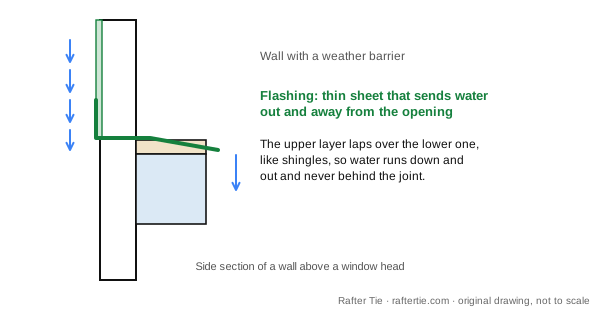
Use this diagram
How to check flashing
- Find the weak points. Look above windows and doors, at the junction of a roof and a wall, around chimneys and penetrations, where a deck or porch attaches to a wall, and above projecting trim. These are the places the code expects flashing.
- Check the lapping order. Water runs down, so the upper piece must lie over the lower one. At a window head, the weather barrier above laps over the flashing, and the flashing laps out over the window. A reverse lap leads water behind the layer.
- Check the material. Flashing is corrosion-resistant. Some metals attack each other or react with treated lumber or masonry, so the material has to be compatible with what it touches.
- Check the ends. Water finds the end of a flashing. Look for turned-up ends or end dams where the flashing meets an obstruction.
- Check the attachment. Fasteners should not be placed where water collects and should not pierce the part that sheds water. Sealant alone is not flashing.
Try one question
Question 1 of the free 10-question check on ICC B1. No signup. Then ask Plumb, the AI study assistant, why the answer is right and the others are wrong.
Public Safety and Special Construction
In a new bedroom, the only emergency escape window has a keyed sash lock, with the key hanging on a hook beside the window. What should the inspector do?
Press A-D or 1-4 to choose an answer while this question is on screen.
Choose an answer to begin
Common mix-ups
- Flashing versus caulk. Sealant is a maintenance item that fails over time. Flashing is a mechanical barrier. A joint relying only on caulk is a finding.
- Flashing versus weather barrier. The weather barrier is the sheet behind the siding. Flashing is the set of pieces that integrate openings and joints with that barrier.
- Wall flashing versus roof flashing. Walls and roofs have separate sections of the code with different requirements. See the step flashing and counterflashing page for the roof-to-wall joint.
- Flashing versus drip edge. A drip edge is a metal strip at the eave or rake of a roof. It is related to flashing but is a separate roofing part.
Ask Plumb before you buy AI your AI study assistant
See what's on the ICC B1 exam, test yourself with 5 quick questions, or find the plan that fits you.
The ICC B1 course
Available now · instant accessLearn how the IRC is laid out, drill finding sections fast, then practice. Written for the 2024 IRC.
- 7modules of lessonsEvery task on the outline
- 4full-length timed exams60 questions in 120 minutes each
- 426practice questionsEach one explained
- 4worked calculationsStep by step
- 8timed code lookups a setFind it fast in IRC, with your median time
- 1week-by-week study planSet to your exam date
Turn a practice answer into a study step. In untimed practice, ask Plumb AI about any question you answer, follow up, then see your weakest topics and what to drill next.
Instant access. Terms and refunds · Secure checkout by Stripe · Billed by Nori Software
Every answer comes with a full explanation.
Flashing on the B1
Exterior wall coverings and flashing are named in the wall construction area, 27% of the B1, and roof flashing falls under the roof assemblies chapter. Expect a location and a question about whether flashing is required, or a lapping order that is right or wrong. Tab the exterior covering flashing section in Chapter 7 and the roof flashing sections in Chapter 9, after confirming the numbers in your edition.
Practice it
Practice finding the sections with the code navigation drill. Then read step flashing versus counterflashing for roof joints, and wall header for the member above the window head you are flashing. The IRC terms glossary links the rest.
Know your flashing? Check the rest of the B1
Take the free 10-question check. It is weighted to the seven B1 areas, scored by area and needs no signup, so you see which area costs you the most points. The Rafter Tie course adds timed practice exams, a lesson for each outline area and a study plan built from your exam date.
Sources
Show the list
- B1 Residential Building Inspector Content Outline, International Code Council.
- 2021 IRC contents and 2024 IRC contents, International Code Council. Chapters are named, not quoted; open your own copy for the text.
Facts come from the sources listed above. If something has changed, tell us and we will correct it within 2 business days.
Your next step
Ready to see where you stand on ICC B1?
Free, untimed and scored by domain. No signup.
Start the free 10-question checkB1 course with IRC navigation drills. Lessons, timed practice exams and a plan around your exam date. Get B1 course with IRC navigation drills · $99 See the plans or read the free sample lesson.Terms and refunds
Want a timed run? Try the free 25-question mini-mock. The first 5 need no email.
Prefer paper? Free printables
- Print the study checklist (free PDF). Topics to cover, on one printable page. No email.
- Print a class quiz (free PDF). 5 practice questions with an answer key on page 2.
- Print the flashcards as cut-out cards (free PDF). The free flashcard sample, ready to cut and carry.
From the blog
- ICC B1 exterior coverings and weather barriers
- ICC B1 roof and ceiling construction: what to know
- ICC B1 egress, stairs and guards: what to measure