Winder stairs: what it means on an inspection
A winder is a tread that is narrower at one end than the other, used to turn a stair without a flat landing. Because the tread has no single depth, the code measures it along the walkline, a path set in from the narrow side. There are minimum depths at the walkline and at the narrowest point.
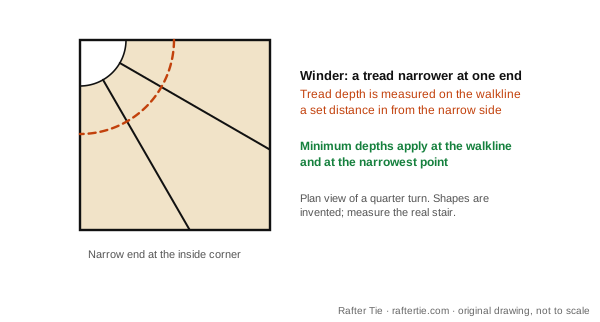
Use this diagram
How to check a winder
- Find the walkline. It is a line a set distance in from the side of the stair where the treads are narrower, running along the path a person would walk. Tread depth is measured here.
- Measure the depth at the walkline. Measure from nosing to nosing along the walkline and compare with the minimum the IRC sets; check the current edition.
- Measure the narrowest point. A winder also has its own, smaller minimum depth at its narrowest point within the width of the stair. The wedge cannot come to a point.
- Compare winders in the same flight. The depths at the walkline within one flight should be consistent. The code limits how much the largest and smallest may differ. Check the limit in your edition.
- Do not forget the rest of the stair. Riser height, headroom, stair width and handrails still apply. The IRC stair check covers the riser and tread limits for straight flights.
Try one question
Question 1 of the free 10-question check on ICC B1. No signup. Then ask Plumb, the AI study assistant, why the answer is right and the others are wrong.
Public Safety and Special Construction
In a new bedroom, the only emergency escape window has a keyed sash lock, with the key hanging on a hook beside the window. What should the inspector do?
Press A-D or 1-4 to choose an answer while this question is on screen.
Choose an answer to begin
Common mix-ups
- Winder versus landing. A landing is a flat platform. A winder is a sloping tread that turns. A turn made with a landing and one made with winders are measured differently.
- Winder versus spiral stair. A spiral stair turns around a center column and has its own relaxed rules. Do not apply winder numbers to it.
- Walkline versus centerline. The walkline is set a fixed distance from the narrow side, not at the middle of the stair. Read that distance in the stair section of your edition.
- Narrow end versus walkline. Both are measured, with different minimums. A tread can pass at the walkline and fail at the narrow end.
Ask Plumb before you buy AI your AI study assistant
See what's on the ICC B1 exam, test yourself with 5 quick questions, or find the plan that fits you.
The ICC B1 course
Available now · instant accessLearn how the IRC is laid out, drill finding sections fast, then practice. Written for the 2024 IRC.
- 7modules of lessonsEvery task on the outline
- 4full-length timed exams60 questions in 120 minutes each
- 426practice questionsEach one explained
- 4worked calculationsStep by step
- 8timed code lookups a setFind it fast in IRC, with your median time
- 1week-by-week study planSet to your exam date
Turn a practice answer into a study step. In untimed practice, ask Plumb AI about any question you answer, follow up, then see your weakest topics and what to drill next.
Instant access. Terms and refunds · Secure checkout by Stripe · Billed by Nori Software
Every answer comes with a full explanation.
Winders on the B1
Stairs are part of public safety and special construction, 17% of the B1. Expect a described winder with two dimensions and a question about which one controls. The stair section is R311.7 in the 2021 IRC and R318.7 in the 2024 edition, so find it by name in your table of contents and confirm the numbers in your own book.
Practice it
Check the general stair limits with the IRC stair check, then read guard versus handrail for the parts of a stair that sit beside the treads. Then run a guard's height and openings through the guard and handrail check. Egress window covers the other half of that area of the book. The IRC terms glossary links the rest of the terms.
Know your stairs? Check the rest of the B1
Take the free 10-question check. It is weighted to the seven B1 areas, scored by area and needs no signup, so you see which area costs you the most points. The Rafter Tie course adds timed practice exams, a lesson for each outline area and a study plan built from your exam date.
Sources
Show the list
- B1 Residential Building Inspector Content Outline, International Code Council.
- 2021 IRC contents and 2024 IRC contents, International Code Council. Chapters are named, not quoted; open your own copy for the text.
- 2021 IRC Chapter 3, Building Planning and 2024 IRC Chapter 3, Building Planning, International Code Council free public access. Stair, handrail and guard rules are cited by topic, not quoted.
Facts come from the sources listed above. If something has changed, tell us and we will correct it within 2 business days.
Your next step
Ready to see where you stand on ICC B1?
Free, untimed and scored by domain. No signup.
Start the free 10-question checkB1 course with IRC navigation drills. Lessons, timed practice exams and a plan around your exam date. Get B1 course with IRC navigation drills · $99 See the plans or read the free sample lesson.Terms and refunds
Want a timed run? Try the free 25-question mini-mock. The first 5 need no email.
Prefer paper? Free printables
- Print the study checklist (free PDF). Topics to cover, on one printable page. No email.
- Print a class quiz (free PDF). 5 practice questions with an answer key on page 2.
- Print the flashcards as cut-out cards (free PDF). The free flashcard sample, ready to cut and carry.
From the blog
- ICC B1 egress, stairs and guards: what to measure
- ICC B1 smoke alarms, safety glazing and flame spread
- ICC B1 wall framing, headers and masonry topics