Notching and boring joists: what it means on an inspection
Notching and boring are cuts in a joist for pipes, wires and ducts. The rules for sawn lumber control where along the span a notch may go, limit notch depth to a fraction of the joist depth and limit hole size and position. Engineered joists and trusses follow their own rules and are not cut in the field.
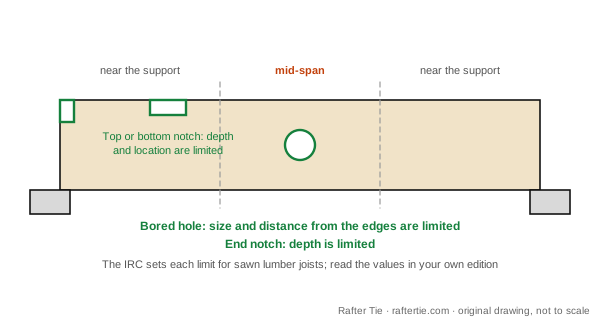
Use this diagram
How to check a cut in a joist
- Identify the member. Solid sawn lumber follows the code's notching rules. An I-joist or other engineered joist follows the manufacturer's instructions, which usually allow holes only in the web in set locations and forbid cutting the flanges. A truss is never cut without engineering approval.
- Find where the cut sits along the span. Bending stress is greatest near mid-span, so the code keeps notches on the top or bottom edge out of the middle part of the span. Read the exact zone in your edition.
- Measure notch depth. The code limits a notch on the top or bottom edge to a fraction of the joist depth, and sets a separate limit for a notch at the end where the joist bears. Check the depth and length limits in your edition.
- Measure holes. The code limits a bored hole to a fraction of the joist depth and sets a minimum distance from the top and bottom edges.
- Count the cuts. The limits apply to each cut and to the combination. Several holes close together, or a notch and a hole in the same spot, weaken the member more than either alone.
Try one question
Question 1 of the free 10-question check on ICC B1. No signup. Then ask Plumb, the AI study assistant, why the answer is right and the others are wrong.
Public Safety and Special Construction
In a new bedroom, the only emergency escape window has a keyed sash lock, with the key hanging on a hook beside the window. What should the inspector do?
Press A-D or 1-4 to choose an answer while this question is on screen.
Choose an answer to begin
Common mix-ups
- Notch versus bore. A notch removes material from an edge. A bored hole removes material from inside the member. The limits differ.
- Floor joists versus studs. Wall studs have their own limits in the wall framing section of Chapter 6. Do not carry joist numbers over to studs.
- Edge distance is from the edge of the hole. The minimum distance is measured to the edge of the hole, not to its center.
- Plumbing convenience is not a code basis. A cut that is easier for the trades does not make it allowed.
Ask Plumb before you buy AI your AI study assistant
See what's on the ICC B1 exam, test yourself with 5 quick questions, or find the plan that fits you.
The ICC B1 course
Available now · instant accessLearn how the IRC is laid out, drill finding sections fast, then practice. Written for the 2024 IRC.
- 7modules of lessonsEvery task on the outline
- 4full-length timed exams60 questions in 120 minutes each
- 426practice questionsEach one explained
- 4worked calculationsStep by step
- 8timed code lookups a setFind it fast in IRC, with your median time
- 1week-by-week study planSet to your exam date
Turn a practice answer into a study step. In untimed practice, ask Plumb AI about any question you answer, follow up, then see your weakest topics and what to drill next.
Instant access. Terms and refunds · Secure checkout by Stripe · Billed by Nori Software
Every answer comes with a full explanation.
Joist cuts on the B1
These cuts are part of floor construction, 14% of the B1, and the numbers are the kind that tests turn into a measurement question. The sawn-lumber limits are in Chapter 5, where cutting and boring of joists is covered; the limits are named above but not given, so read them in your edition and tab the section so you can find it in under a minute.
Practice it
Build the habit of finding the section fast with the code navigation drill. Then read band joist, the member at the edge of the floor that also takes trade cuts, and bearing wall versus non-bearing wall, which affects stud cuts in walls. The IRC terms glossary has the rest.
Know your joist cuts? Check the rest of the B1
Take the free 10-question check. It is weighted to the seven B1 areas, scored by area and needs no signup, so you see which area costs you the most points. The Rafter Tie course adds timed practice exams, a lesson for each outline area and a study plan built from your exam date.
Sources
Show the list
- B1 Residential Building Inspector Content Outline, International Code Council.
- 2021 IRC contents and 2024 IRC contents, International Code Council. Chapters are named, not quoted; open your own copy for the text.
Facts come from the sources listed above. If something has changed, tell us and we will correct it within 2 business days.
Your next step
Ready to see where you stand on ICC B1?
Free, untimed and scored by domain. No signup.
Start the free 10-question checkB1 course with IRC navigation drills. Lessons, timed practice exams and a plan around your exam date. Get B1 course with IRC navigation drills · $99 See the plans or read the free sample lesson.Terms and refunds
Want a timed run? Try the free 25-question mini-mock. The first 5 need no email.
Prefer paper? Free printables
- Print the study checklist (free PDF). Topics to cover, on one printable page. No email.
- Print a class quiz (free PDF). 5 practice questions with an answer key on page 2.
- Print the flashcards as cut-out cards (free PDF). The free flashcard sample, ready to cut and carry.
From the blog
- ICC B1 floor construction: joists, subfloor and crawl spaces
- ICC B1 egress, stairs and guards: what to measure
- IRC wall bracing for inspectors: lines and panels